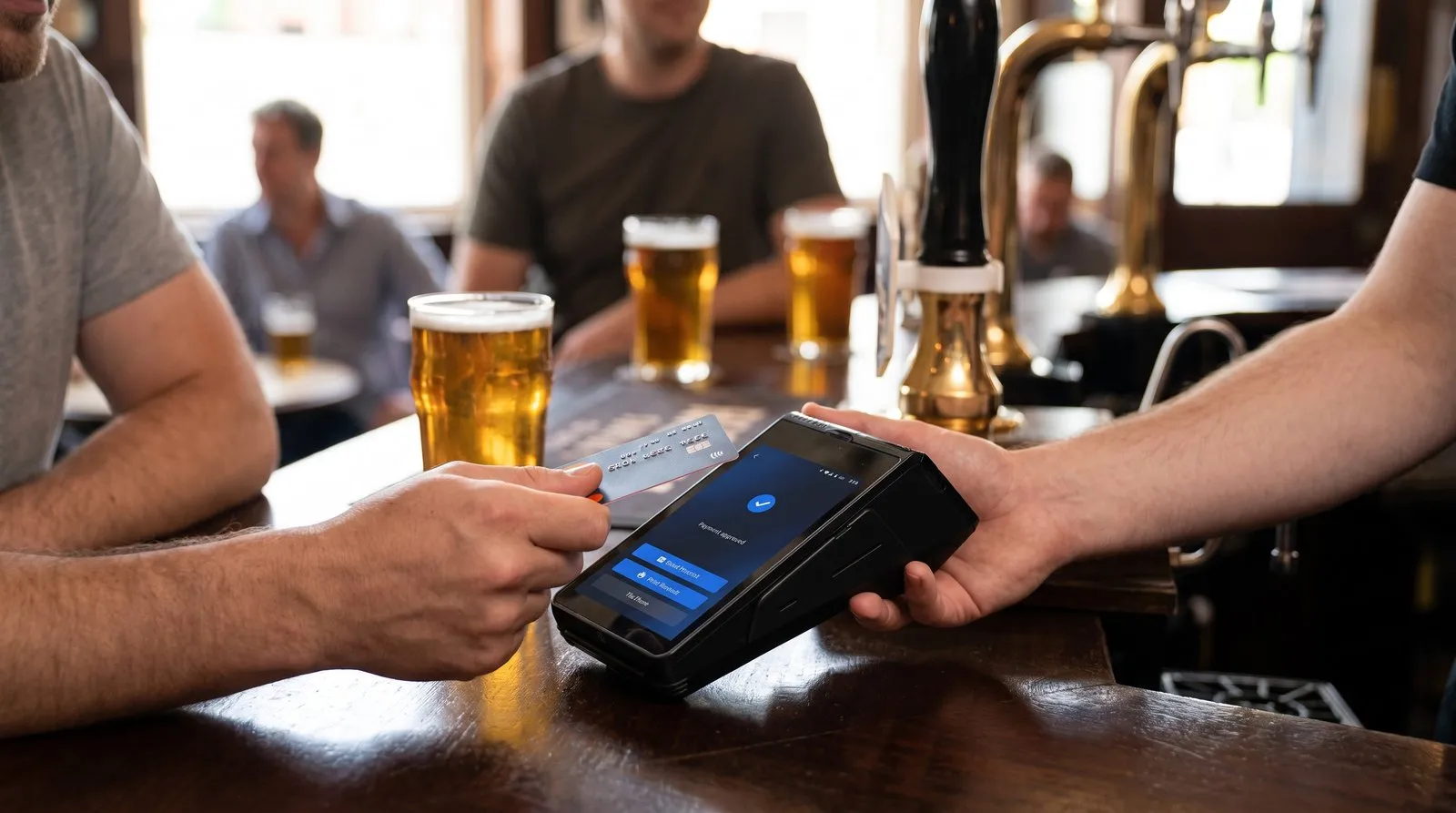
A card reader costs from £29 and takes 1.75 per cent of everything you sell through it. That is a real price, published openly, and for plenty of businesses it is the right answer.
It stops being the right answer somewhere, and the regulator has already told you roughly where.
Every card payment you take runs through a merchant account held with the card schemes. You either have one of your own, priced to your business, or you trade underneath somebody else's.
The second shape is a payment facilitator. The Payment Systems Regulator puts it plainly in its market review into card acquiring services, reference MR18/1.8, November 2021: "Payment facilitators are intermediaries between acquirers and merchants." They sign you up without underwriting, sell you the hardware outright, and give you one published rate that every one of their customers pays.
The first shape is your own account with an acquirer. There is underwriting, there is a quote rather than a price list, and what you are offered depends on your turnover and on what cards your customers actually hand over. It is more work to arrange and it is the only one of the two where the number is yours rather than everybody's.
Neither is a trick. They are two different products that happen to do the same job at the counter.
The same review draws its own boundary at £15,000 of card turnover a year. The PSR states that it does "not make a finding for merchants with annual card turnover up to £15,000", because that end of the market is served mainly by payment facilitators, which it says "tend to focus on serving merchants with low levels of card turnover".
£15,000 a year is £1,250 a month. Fifteen thousand divided by 12 is 1,250. A market stall, a mobile therapist, a weekend trader: the flat rate was built for them and it serves them well.
A pub takes that before the first Saturday is out.
The published in person rates are easy to check. Square lists 1.75 per cent for transactions with UK cards. Zettle lists 1.75 per cent per transaction, with readers from £29 excluding VAT. SumUp lists 1.69 per cent on its pay as you go plan, and its readers at £25 for the Solo Lite, £79 for the Solo and £135 for the Terminal, all excluding VAT.
Run those numbers at the boundary and at a real venue.
At £15,000 of card turnover a year, 1.75 per cent is £262.50 a year. Nobody is renegotiating anything over £262.50, and nobody should.
A venue taking £15,000 a month turns over £180,000 a year on cards. At 1.75 per cent that is £3,150 a year, on a price nobody quoted you and nobody can move.
Part of what you pay on every card sale is interchange, which goes to the bank that issued your customer's card. The Payment Systems Regulator caps it in the UK at 0.2 per cent of the transaction value for consumer debit cards and 0.3 per cent for consumer credit cards, where you, your provider and the issuing bank are all in the UK.
On that same £180,000, mostly consumer debit, interchange at 0.2 per cent is £360. Take £360 off £3,150 and £2,790 is left. That remainder covers scheme fees, the provider's own costs and its margin, and it is the part of the bill that any pricing conversation is actually about. If you want the mechanics of how that remainder gets packaged, we wrote about interchange plus against blended pricing separately.
A flat rate is not a swindle. It is one price built to cover every kind of merchant at once, from the risky to the dull. If your business is one of the dull ones, you are paying for the risky ones too, and you have no way of saying so.
Buried in the same PSR review is the single most useful sentence anyone has published about this market. Of merchants who tried to negotiate with their existing provider, "nearly 90% of those that did were successful in getting a better deal".
Not switched. Negotiated, with the people they were already paying.
That is the answer to the late night search for the cheapest card reader. Below the £15,000 boundary, cheap is a price list and you take it or leave it. Above it, cheap is a conversation that almost everybody who has it wins, and most operators never have.
A quoted account does not remove interchange or scheme fees. They are a floor, and no provider can price beneath them.
It does not help if your card mix is expensive. Commercial cards, corporate cards and cards issued outside the UK sit outside those caps, so a hotel taking a lot of overseas bookings will not see the same improvement as a pub on consumer debit.
It does not touch the rest of the bill either. The rate is one line among several, and the other charges under it are where a good headline rate quietly turns into an ordinary one. The same goes for the fixed amount charged on every authorisation, which matters most if your average sale is small.
And it is not automatic. An acquirer underwrites a business before it prices one.
What was my card turnover over the last 12 months, from statements rather than memory. That single number decides which market you belong in.
What is my split between consumer debit, consumer credit and anything commercial or international. Ask your provider for it in writing. They have it.
What am I paying in total, not as a rate. Add up 12 months of every line on the statement and divide by the turnover. That is your real cost, and it is usually higher than the number you think you are on.
What happens to the hardware. A reader you bought outright is yours and a free one usually is not, which is a question of what the word free is covering rather than a reason to stay put.
We do charge an authorisation fee, priced per contract, and there are terms that are not published on this website. We do not charge a PCI compliance fee. Hardware, installation and upfront cost are free.
Your rate depends on your turnover and your card mix, and we will quote it before you commit to anything.
If you want a sense of the size of the gap before you speak to anybody, put last week's card takings and your current rate into the savings calculator on our pricing page. It is an estimate rather than a quote.
The device and the processing are two separate bills. Published reader prices run from £25 for a SumUp Solo Lite and from £29 for a Zettle reader, both excluding VAT, up to £135 for a SumUp Terminal. The processing is the larger number over a year: on £180,000 of card turnover, a flat 1.75 per cent is £3,150.
They are what your acquirer charges to accept and process card payments on your behalf. The largest component is usually interchange, capped in the UK at 0.2 per cent on consumer debit and 0.3 per cent on consumer credit, with scheme fees and the acquirer's own margin on top. On a flat rate plan all of that is rolled into one published percentage.
If your card turnover is near the £15,000 a year mark that the Payment Systems Regulator uses as its boundary, the cheapest answer is genuinely a published flat rate plan, and the reader itself costs £25 to £135. Well above that, the cheapest answer stops being a price list and becomes a quote, which is why nearly 90 per cent of merchants who negotiated with their provider got a better deal.
Send three months of card statements and one busy Friday. We will show you what your card processing is costing you now against what it would cost with us, with every fee named, before you commit to anything.
Get my quote WhatsApp