Costs have gone one way for three years and the room to pass them on has closed.
In research published on 30 June 2026, UKHospitality, the British Beer and Pub Association, the British Institute of Innkeeping and Hospitality Ulster reported that 23 per cent of hospitality businesses are operating at a loss, up from 15 per cent three months earlier, and that one in six is at risk of failure within twelve months. The survey ran from 19 May to 9 June 2026 and covered operators representing more than 16,000 venues.
A year earlier the same four bodies reported that a third of businesses were operating at a loss and that 76 per cent had already put prices up.
That second number is the one that matters here. If three quarters of the market has already raised prices, raising them again is not a strategy. It is the thing you do before you close.
Which leaves spend per head. Same guest, same door, same rent, more in the basket.
Everything below is our own data, from named venues, and it is worth being precise about whose technology produced it.
These are eMenu customers running eMenu's ordering technology. eMenu is the team behind Shift4Pay. Shift4 POS is a separate product, and none of the numbers below came from it.
Nick, Food and Beverage Project Manager, reports that 32 per cent of food and beverage sales now come through in room ordering. All of it is incremental, because a guest sitting in a room previously had no way to order at all.
Sales growth of 5 to 6 per cent. Spend per sleeper up 40 to 50p. The group is targeting £100m in food and beverage revenue by 2027.
April runs the site, an Admiral Taverns pub. Spend per head up about 40 per cent. Ninety per cent of kitchen orders now arrive through the system rather than being carried to the pass. Tips up tenfold.
The site reports that QR ordering brings in more than double the sales of the other channels it runs.
The site reports that most sales now come through QR. It had previously tried a different EPOS system that did not last.
Part of Arriva, and the outlier in this list. One customer service assistant now covers an entire moving train, with each order routed to the correct service. It is not a pub, and we are not going to pretend it reads across to one. It is here because it is the extreme version of the same mechanism.
Four reasons, and none of them are about the software being clever.
Every venue trains its team to ask. On a Tuesday at three o'clock they ask. At half seven on a Saturday with a queue three deep, they do not, because they are trying to get through the queue.
The prompt on a screen has no such Saturday. It asks every single time, in exactly the same words, whatever is happening in the room. As Nick at Travelodge puts it, technology never forgets the brand standards a busy person does.
A second round is a decision made against the cost of standing at a bar for six minutes. Remove the six minutes and the decision changes. This is most of what happened in a Dartford garden and most of what happens on a Saturday anywhere.
Nobody reads a menu properly with a server standing over them. On a phone, at the table, with no one waiting, people scroll. Sides get noticed. Puddings get noticed at the point the main is being ordered rather than forty minutes later when everyone is full.
Ninety per cent of Dartford's kitchen orders arriving through the system is not a technology statistic. It is a count of walks that no longer happen, and of the time those walks used to eat.
It does not fix a slow kitchen. If your pass is already thirty minutes behind, faster ordering makes the queue longer, not shorter.
It does not fix a menu nobody wants. Higher spend per head comes from people buying more of something they already like.
In room ordering only works where there is a kitchen open to take it, which is why the Travelodge number is a hotel number and not a universal one.
And it is not free of effort. Somebody has to build the menu properly, write the prompts and keep them current. Venues that treat it as a switch to flick get a fraction of the result.
Take the area where the walk to the bar is longest. A garden, a terrace, a first floor, a function room.
Measure spend per head there for four weeks. Not covers, not takings. Spend per head.
Turn it on in that area only, keep everything else the same, and measure four more weeks. If spend per head has not moved, the problem was never the ordering.
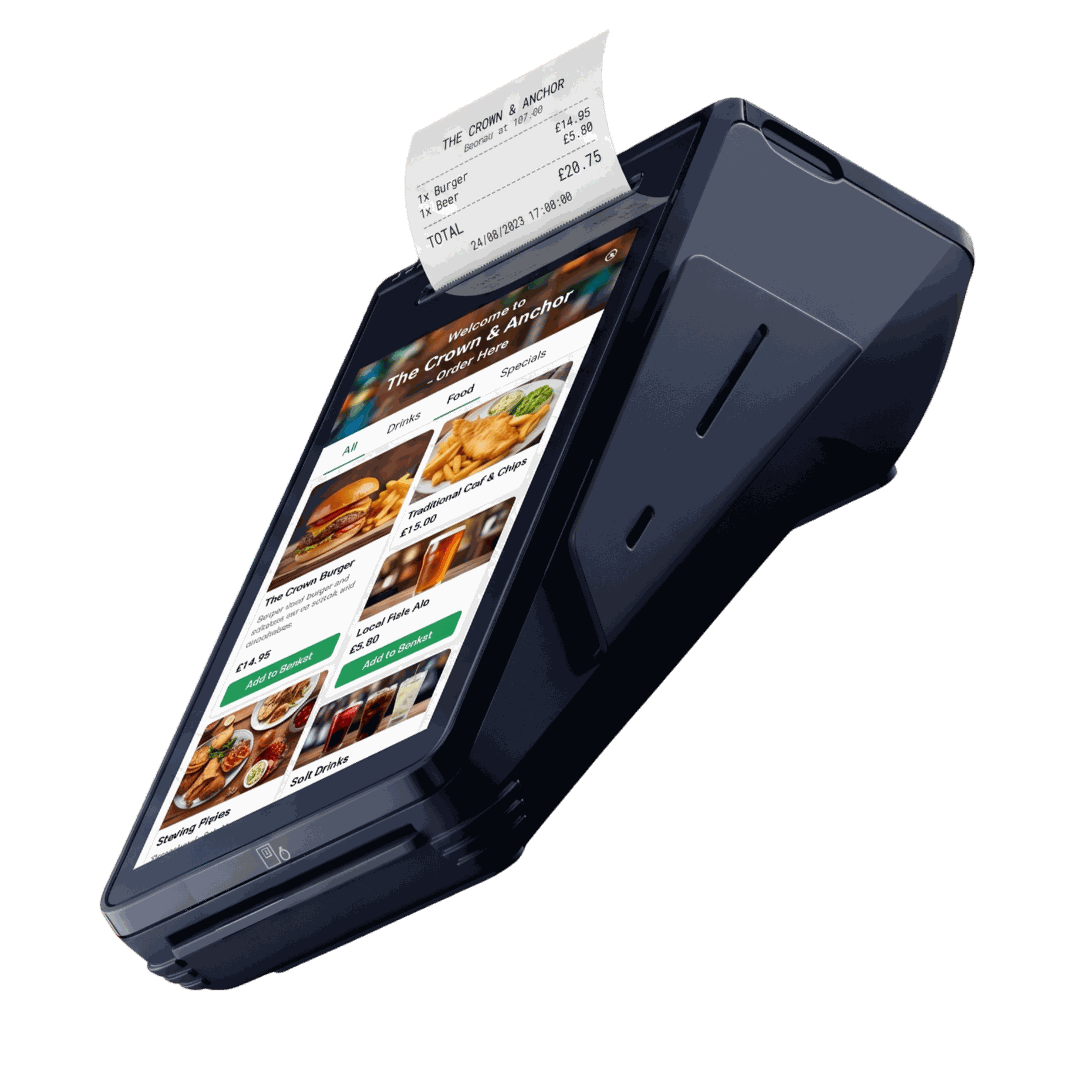
If you want to see what the hardware looks like in a hand, the handheld ordering page covers it. If the question is your own ordering page against the marketplaces, that is on the online ordering page. And every venue named above is on film, by name, on our case studies page.
Send three months of card statements and one busy Friday. We will show you what your card processing is costing you now against what it would cost with us, with every fee named, before you commit to anything.
Get my quote WhatsApp